Now that we have engaged in the interconnection between our fallen Monster and our fallen angel, I want to spin our attention to another Victorian mystic rarely spoken of, who exemplifies pleasurable, spiritual, pain; Helen in Charolette Bronte’s Jane Eyre.
When Jane first meets Helen it is at Lowood, a boarding school. She was fascinated by the girl’s quietness. Their friendship was a resemblance of the phrase ‘opposites attract’, as the child-version of Jane was extremely fierce and outspoken while Helen was extremely quiet and observant. Some would say that she foreshadows the adult version of Jane because as the years flew by, Jane became extremely observant just like Helen. But we are not here to speak on the positivity of quietness. It is actually Helen’s quietness that makes her a mystic.

The picture above is meant to show Helen as a young child, standing in front of her class while being whipped by her teacher. The scenario, from Volume I, chapter 6, reads as follows:
“This ominous tool she presented to Miss Scatcherd with a respectful courtesy; then she quietly, and without being told, unloosed her pinafore, and the teacher instantly and sharply inflicted on her neck a dozen strokes with the bunch of twigs. Not a tear rose to Burn’s eye; and, while I paused from my sewing, because my fingers quivered at this spectacle with a sentiment of unavailing and impotent anger, not a feature of her pensive face altered its ordinary expression.”1
Like Margery Kempe, or maybe even more powerfully, Helen mimics the silence and pain of Jesus during the Crucifix. She is forced to stand in front of her entire class, just like Jesus is forced to hang in front of everyone. She is painfully punished and stands in silence without “a tear” in her eyes, Just like Jesus.
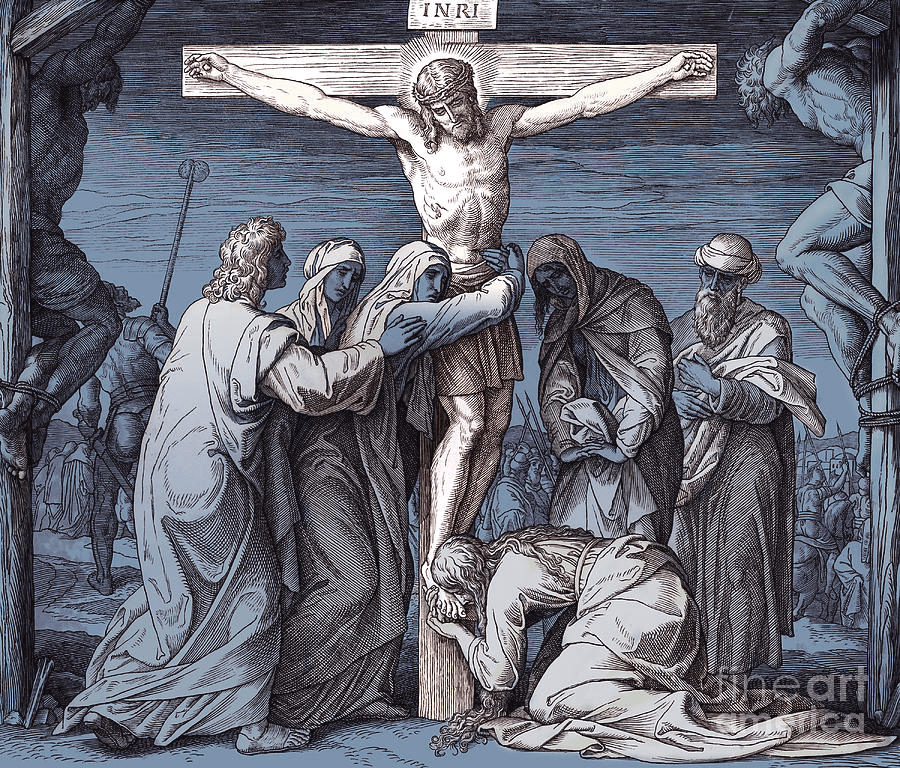
She, thus, embodies the pain of her saintly figures just like a mystic would. She also seems to embody the persona of a Virago. In one of my first blogs, I mentioned how a virago disembodies her femininity, and fully embraces her masculine, Christian, virtues in order to resemble Christ. In this scene, Helen does the exact same: she embodies the Christ-like virtues in order to be closer to Christ’s humanity.
The virago is also a unique individual in history because they often become Saints. After Helen dies of consumption, she also becomes a saint-like figure in Jane’s life: “Her grave is in Brockelbridge churchyard: for fifteen years after her death, it was only covered by a grassy mound; but now a grey marble tablet marks the spot inscribed with her name, and the word ‘Resurgam’.”2 The word ‘Resurgam’ is Latin for ‘I shall rise again’ (OED). In this instance, Helen takes up not only the mystical aspiration of the feminization of Christ, but also her capacity of becoming a martyr- like Saint. She died of consumption, but without a peep. She allowed the love for her religion to guide her through the pain, just like any other martyr-like Saint would do.
Jane is another primary example of Helen’s mystical martyrdom, as Helen’s spirit continues to live on within Jane and her journey. At the end of the novel, when Helen dies, they lay in each other’s arms as if they are inseparable, showcasing the great connection that humans have with God. Just like Jesus, once again, Helen will always be with Jane, even if it is in memory or in spirit. She will always ‘rise again’ throughout Jane’s life.
Helen is one of the most unique characters I will be writing about in this series. She is often left out of the scholarly world, as many tend to focus on other important themes within the novel such as race, colonization, love, friendship, marriage, etc. Helen, however, represents the reason why Jane’s character turned out the way that she did: quiet, reserved, and observant.



 AGblogs
Leave a comment